Universal Non Breathable Roof Underlay 45m x 1m from Marley | Swansea
Product Code: MAR1/MA33145
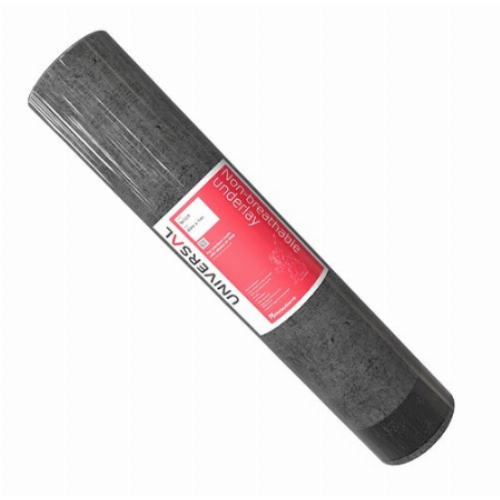


Universal Non Breathable Roof Underlay 45m x 1m
Universal Non Breathable underlay is a 116g/m² membrane that comes packed full of features and benefits designed to promote consistent installation to the British Standard:
- Non-breathable
- High tensile and tear strength
- Clean and easy to handle
- Durable
- UV resistant
- BBA approved – Certificate no. 16/5334
- Lightweight alternative to traditional IF
- Integrated tape for sealing laps
- Guidance lines for minimum laps
Advantages
Integrated tape system for sealing underlay laps
- Creates an impervious barrier with superb wind-uplift resistance
- No need to increase laps to coincide with tile batten courses, minimising cost
- No need to use an additional ‘fly’ batten to secure laps
Printed guidance lines
- Provide a visual reference to ensure sufficient lap to the British Standard
- Ensure that the underlay is laid consistently and straight
Universal Non Breathable underlay integrates seamlessly as part of a comprehensive Marley roof system, or with other manufacturers’ tiles and slates.
Universal non-breathable underlay is a lightweight, high performance membrane for pitched roofs. Supplied in 1m x 45m rolls with integrated tape for sealing laps, the underlay is fully compliant to BS 5534 and suitable for all UK wind zones 1-5. Universal non-breathable underlay is designed to integrate seamlessly within a full Marley Eternit roof system and is suitable for roofs with traditional ventilation products or ventilated batten cavities.
|
Minimum Overlaps |
|||
|
Roof pitch (°) |
Horizontal laps (mm) |
Vertical laps (mm) |
|
|
|
Not fully supported |
Fully supported |
|
|
12.5 - 14 |
225 |
150 |
150 |
|
15 - 34 |
150 |
100 |
150 |
|
35+ |
100 |
75 |
150 |
|
Zonal classification label for Universal non-breathable underlay |
||
|
Product |
Identification |
Manufacturer |
|
Universal nonbreathable underlay |
Code MA33145 |
Marley Eternit Ltd |
|
Batten gauge D |
Declared wind uplift resistance PD (pa) |
Zone suitability |
|
≤345mm with integrated taped laps |
>1600 |
1 to 5 |
BS 5534 requirements
BS 5534 Code of practice for slating and tiling indicates that a roofing underlay should achieve the following:
- Provide a barrier to minimize the wind uplift load acting on the slates or tiles
- Provide a secondary barrier to the ingress of wind-driven rain, snow and dust
- Transport into the roof drainage system any moisture in the batten space
BS 5534 establishes the resistance to wind uplift of the underlay and a classification system aimed at preventing ‘ballooning’ under wind load, which in certain circumstances can place a load on the underside of the roof covering. As a result, stricter recommendations for the securing of laps have been introduced. These assist with the specification and installation of underlays, based on their declared wind uplift resistance in five UK geographical wind zones. Consideration should be given to fixing penetrations through the underlay. Such penetrations should not be subject to enlargement caused by shrinkage or nail tear as a result of wind uplift loading, and should be sealed where required to prevent water ingress. Only underlays suitably labelled and meeting the new standard should be installed.


